




ORGANS OF PARIS © 2026 Vincent Hildebrandt HOME ALL ORGANS



Even in the 19th century, the area now known as Paris
consisted of a series of small towns in the countryside,
apart from medieval Paris itself. In 1824, the village of
Batignolles had five thousand inhabitants and
depended on Clichy. It was decided to build a church,
and a subscription was launched. The small amount
raised only allowed the construction of a chapel,
completed in 1829. But the population kept growing,
and the chapel was enlarged by Paul‑Eugène Lequeux
(1806–1873). Respecting the Latin cross layout, he
added the two side aisles, the transept and the choir,
completed in 1851. The building is inspired by the
ancient Roman basilica, and its porch resembles that
of a Greek temple. The interior bears the mark of
churches built under the Restoration:
Sainte‑Marie‑des‑Batignolles is a sober, almost
severe church. Fortunately, a flat ceiling with painted
compartments and a superb 19th‑century choir with a
magnificent sculpted retable soften this sobriety and
enhance the building.

C5
In the second half of the nineteenth century, the church
of Sainte-Marie des Batignolles had a large Stoltz organ
(36 stops), which operated until July 1912. The First World
War halted all reconstruction projects. During the
unavailability of this instrument, it is the accompanying
organ, installed in the choir, which is used. It is a 16-stop
Merklin, built around 1880. tIt was transferred in 1918 to
Saint-André d'Antin without being replaced.
1923
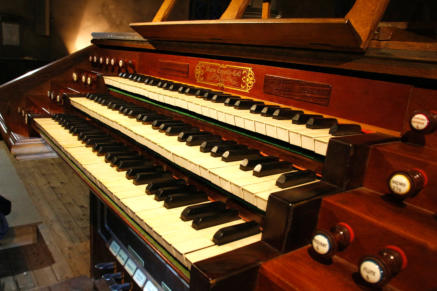
A new great organ was built in the tribune on the reverse
of the main façade by Mutin-Cavaillé-Coll.
1936
The organ underwent a complete overhaul by Gloton-
Debierre.
1947
A restoration and transformation was carried out by the
same factory (now Beuchet-Debierre): several
modifications are made, steering the instrument’s tonal
palette towards a neo‑classical aesthetic with changes in
the stoplist: Terciane on the Positif, change of the Plein
Jeu GO.
Regularly maintained for twenty years, it then
deteriorated rapidly: in 1982, it was completely unusable.
1991-1994
Dargassies completely restored it, adding seven stops*.
He kept the best of Mutin, but replaced the demilength
Bombarde 16 Pédale with a full‑length one, and the
Terciane with a plain Tierce. The high‑pressure Montre 8
on the Great had been very badly damaged, so he
replaced those pipes. The question arose with the
Salicional 8 on the Positif, as a Doublette was desired in
order to complete the Tierce mixture. After much
discussion and considering different opinions, the
Doublette was finally chosen. It should be noted that the
pipes of the Salicional were kept, so the operation
remains reversible. The Tuba on the Great was sounding
very dull and was replaced by a classical Trompette made
of fine tin. The heavily altered Plein Jeu was replaced by a
new four‑rank one. The pneumatic pedal action was
converted to electric.
Dargassies aimed to preserve the Mutin aesthetic, especially
with this large and impressive symphonic Récit. The
foundations of the Great and Positif are strongly symphonic,
while the mutation stops are balanced within the overall
sound, without betraying the instrument’s identity. The Great
Plein Jeu is rather classical but not sharp; that was a
unanimous choice.
2011
Dargassies restored the wind supply.
*thanks to Mr Bernard Dargassies for these informations.


1923 - Mutin (1)
1936 - Gloton-Debierre (6)
1947 - Beuchet-Debierre (3a)
1994 - Dargassies (3a)
2011 - Dargassies (6)
III/36 - mechanical traction
Stoplist
Titular organist
Simon Prunet-Foch
Famous organists in the past: André Messager, Henti
Busser (titulaires de l’ancien orgue Stoltz), Joseph Bonnet,
Joachim Havard de la Montagne.
Parish website
Videos
Simon Prunet-Foch
Photos of the pipes
Photos
Organ: Jeroen de Haan
Church: Vincent Hildebrandt








The organs of Paris


ORGANS OF PARIS © 2026 Vincent Hildebrandt
C5
In the second half of the nineteenth century, the church of
Sainte-Marie des Batignolles had a large Stoltz organ (36
stops), which operated until July 1912. The First World War
halted all reconstruction projects. During the unavailability of
this instrument, it is the accompanying organ, installed in the
choir, which is used. It is a 16-stop Merklin, built around
1880. tIt was transferred in 1918 to Saint-André d'Antin
without being replaced.
1923
A new great organ was built in the tribune on the reverse of
the main façade by Mutin-Cavaillé-Coll.
1936
The organ underwent a complete overhaul by Gloton-
Debierre.
1947
A restoration and transformation was carried out by the
same factory (now Beuchet-Debierre): several modifications
are made, steering the instrument’s tonal palette towards a
neo‑classical aesthetic with changes in the stoplist: Terciane
on the Positif, change of the Plein Jeu GO.
Regularly maintained for twenty years, it then deteriorated
rapidly: in 1982, it was completely unusable.
1991-1994
Dargassies completely restored it, adding seven stops*. He
kept the best of Mutin, but replaced the demilength
Bombarde 16 Pédale with a full‑length one, and the Terciane
with a plain Tierce. The high‑pressure Montre 8 on the Great
had been very badly damaged, so he replaced those pipes.
The question arose with the Salicional 8 on the Positif, as a
Doublette was desired in order to complete the Tierce
mixture. After much discussion and considering different
opinions, the Doublette was finally chosen. It should be
noted that the pipes of the Salicional were kept, so the
operation remains reversible. The Tuba on the Great was
sounding very dull and was replaced by a classical Trompette
made of fine tin. The heavily altered Plein Jeu was replaced
by a new four‑rank one. The pneumatic pedal action was
converted to electric.
Dargassies aimed to preserve the Mutin aesthetic, especially with
this large and impressive symphonic Récit. The foundations of
the Great and Positif are strongly symphonic, while the mutation
stops are balanced within the overall sound, without betraying
the instrument’s identity. The Great Plein Jeu is rather classical
but not sharp; that was a unanimous choice.
2011
Dargassies restored the wind supply.
*thanks to Mr Bernard Dargassies for these informations.


1923 - Mutin (1)
1936 - Gloton-Debierre (6)
1947 - Beuchet-Debierre (3a)
1994 - Dargassies (3a)
2011 - Dargassies (6)
III/36 - mechanical traction
Stoplist
Titular organist
Simon Prunet-Foch
Famous organists in the past: André Messager, Henti Busser
(titulaires de l’ancien orgue Stoltz), Joseph Bonnet, Joachim
Havard de la Montagne.
Parish website
Videos
Simon Prunet-Foch
Photos of the pipes
Photos
Organ: Jeroen de Haan
Church: Vincent Hildebrandt

